You called the front desk for a whitening quote and heard “it depends,” along with an invitation to come in for a consultation. Now you’re wondering what it actually depends on, and whether that’s code for “we’ll tell you a higher price once you’re in the chair.” That worry makes sense, especially if visiting the dentist already makes you a little anxious. At Gaston Dental Associates in Gastonia, the consult exists because your starting shade, your goal shade, and how your enamel responds to whitening gel all affect how many treatments you’ll need and what the final cost will be. This article breaks down what goes into that number so you know what to expect before you sit down. If the question on your mind is simply “How much is a full set of teeth whitening?”, you’ll find typical price ranges here, the math on how long your money lasts, and the questions worth asking before you pay for anything.
How Much Is a Full Set of Teeth Whitening at a Gastonia Dentist?
Professional whitening for a full set of teeth typically costs $300 to $800 for in-office treatment and $150 to $400 for a take-home kit with custom trays made by your dentist. These are general industry ranges, not a Gaston Dental Associates price list. Your exact price depends on your starting shade, your goal shade, and how many sessions you need.
A “full set” means both arches: your upper and lower teeth, focused on the ones that show when you smile. This detail matters more than most people expect, because some offices and online ads quote prices per arch. A number that looks low may only cover half your smile. When you compare quotes, ask one simple question: does this price cover both my upper and lower teeth?
Here is how the main options compare at a glance:
| Whitening option | Typical cost for a full set | Time to results | Who manages it |
|---|---|---|---|
| In-office professional whitening | $300 to $800 | One visit, often under two hours; some patients need two or three visits | Your dental team, in the chair |
| Dentist take-home kit with custom trays | $150 to $400 | About two to three weeks of daily wear | You at home, with check-ins from your dentist |
| Over-the-counter strips and gels | $20 to $100 | Several weeks, with results that vary by person | You alone |
The spread inside each range comes from the details of your case. In-office prices climb when you need more than one session, when the system uses a special light, or when you pair an in-office visit with take-home trays to keep your shade later. Take-home kits cost more when they include extra gel or follow-up visits.
Gaston Dental Associates provides cosmetic dentistry alongside routine checkups and cleanings, preventive care, restorative dentistry, and emergency dental care in one Gastonia office. Ask at your visit which whitening options the team offers for your situation. Having comprehensive services in one convenient location matters for whitening more than you might think. If your exam turns up a small cavity or an old filling that needs attention, you can take care of it in the same office before you whiten. You won’t be sent to a separate practice or need to start over with a new team.
Why Would Two People Get Different Quotes for the Same Whitening?
Whitening is priced by how far your teeth need to go, not as one flat menu item. Two people can sit in the same chair on the same day and get different quotes because their starting shade, goal shade, type of staining, and enamel health are different.
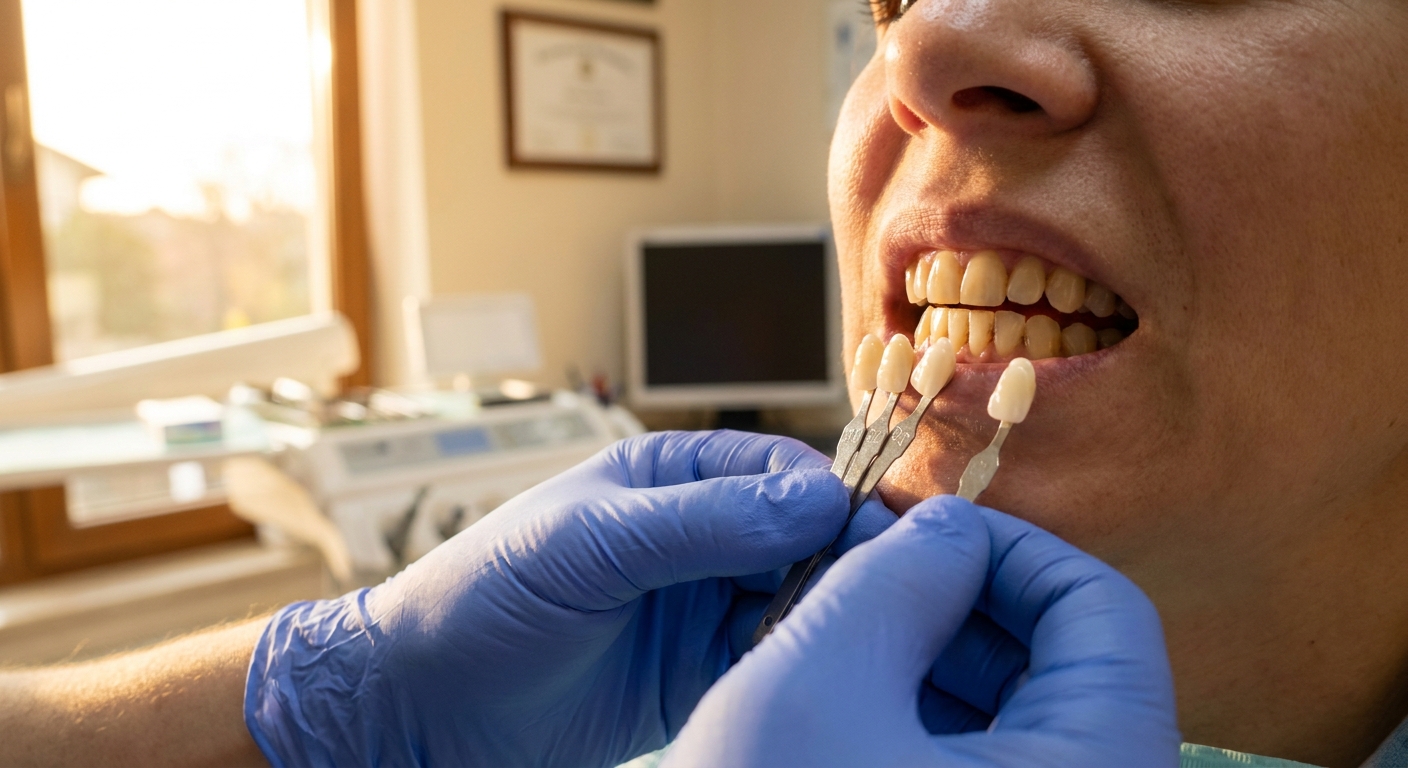
The first step at a whitening consult is measuring where you are starting. Dentists commonly use a shade guide such as the VITA scale, which is a set of tooth-colored tabs arranged from lighter to darker and held next to your teeth in good light. Your dentist records your starting shade, and together you talk about a realistic goal shade. The gap between the two, along with how your teeth tend to respond, shapes the plan. If your staining is moderate, you may reach your goal in one in-office visit, though response varies from person to person. If you start darker or want a dramatic change, two or three appointments may be the honest estimate.
These are the factors that move your final price up or down:
- Your starting shade. Darker teeth usually need more gel time, more sessions, or both.
- Your goal shade. A small, natural brightening costs less than a bright, dramatic change.
- The type of stain. Surface stains from coffee, tea, and tobacco may respond differently than stains that come from inside the tooth, such as those linked to certain medications or an injury. The American Dental Association explains the difference between these two stain types and why it changes your approach.
- Crowns, veneers, fillings, and bonding. Whitening gel does not change the color of these materials. If you have a crown on a front tooth, your plan may include matching or replacing it after whitening, which is restorative work that adds cost.
- Gum and enamel health. Cavities, exposed roots, or gum irritation should be treated first so the gel does not cause pain.
- Your sensitivity history. If your teeth are already sensitive, a slower pace with shorter sessions may be kinder to you, even if it takes more visits.
- The method you choose. In-office, take-home, or a combination of both all come at different prices.
- Touch-ups. Planning for future upkeep now can save you from paying full price again later.
This is why a phone quote can only ever be a range. The consult is where personalized care turns that range into a real number, and it is your chance to ask for that number in writing before you agree to anything.
Should You Pay More for In-Office Whitening or Save With Take-Home Trays?
Choose in-office whitening if you want the fastest visible change, with your dental team watching for sensitivity as you go. Choose take-home trays if you want professional-grade gel for roughly half the cost and you know you will wear the trays every day.
Here are the main whitening methods and what they typically cost for a full set:
- In-office whitening, $300 to $800: high-strength gel applied in the chair, with some patients seeing results in one visit.
- Light-activated in-office whitening, usually toward the top of the range: a light is added to the in-office process. Ask what the light adds in your specific case before you pay extra for it.
- Custom take-home trays, $150 to $400: trays molded to your teeth, plus professional gel you wear at home.
- Combination plans, varies: an in-office visit for a quick start, then trays to keep or fine-tune the shade.
- Over-the-counter strips and gels, $20 to $100: lower-strength products with a one-size-fits-all fit.
- Whitening toothpaste, a few dollars per tube: helps remove surface stains but does not change the natural color of your teeth.
In-office whitening costs more because you are paying for strength, speed, and supervision. Your gums are covered with a protective barrier, a higher-concentration gel is applied with care, and the team checks on you during treatment. If you start to feel sensitivity, they can adjust the timing instead of letting you push through it. Gaston Dental Associates gives special comfort and respect to anxious patients, and this is where that matters: you are not left alone to guess whether a twinge is normal.
Take-home whitening begins with molds of your teeth so your trays fit snugly. You get professional gel at a lower concentration and wear the trays for about 30 minutes to an hour a day for two to three weeks. Dentist-supervised tray whitening is one of the most studied whitening methods, and a review of whitening research notes that tooth sensitivity is the most common side effect and is usually temporary. Check-ins with your dentist help you catch sensitivity early and track your progress.
The honest catch with trays is consistency. If you skip nights, your results stall and your money sits in a drawer. That is why a good consult includes a frank conversation about your schedule. If you work late shifts or have little ones who need you at bedtime, in-office whitening may actually be the better value, even though it costs more upfront. Bring your routine to the conversation so the team can recommend the option that fits your life.
Is Professional Whitening Worth It When You Do the Math Per Month?
For some people, yes. Published studies report professional whitening results lasting anywhere from several months to three years, and duration varies widely from patient to patient. Across that range, a $500 treatment works out to about $83 per month if results last six months and about $14 per month if they last three years, and with personalized care your dentist can estimate where you are likely to fall. How long your results last depends mostly on what you eat, drink, and smoke.
Looking at whitening as a monthly cost changes the decision. Say you choose a $400 take-home kit and your results hold for three years, which comes to about $11 a month. Now compare that to buying a $50 box of drugstore strips four times a year to chase a brighter shade. That adds up to $200 a year, and you may never reach the result you wanted. The cheaper option on the shelf is not always the cheaper option over time.
You can also think about cost per shade. At your consult, ask how many shades of change might be realistic for your teeth, and ask whether the office has before-and-after examples of patients who started near your shade. If one option is likely to move you several shades and another only a little, divide each price by the expected change. This helps you compare value, not just sticker price. Keep in mind that every mouth is different, and response varies from person to person.
Small habits after whitening may help protect what you paid for. Some patients’ teeth are more likely to pick up stains in the first 48 hours, so limiting coffee, red wine, tea, and dark sauces during that window may be helpful. After that, using a whitening toothpaste a few times a week may help remove new surface stains. Touch-up treatments every 12 to 18 months, often just one session or a few nights with gel in the trays you already own, can help maintain your shade without starting over. Hold on to your custom trays, because touch-up gel costs far less than a whole new kit. Your routine cleanings help here too, since your hygienist removes surface buildup that dulls your shade.
Still, whitening is not the best value for everyone. If your front teeth have crowns or large fillings, or if your staining is deep inside the tooth, gel alone may not give you the look you want. In those cases, another cosmetic or restorative option may be a better fit. Because Gaston Dental Associates provides cosmetic and restorative dentistry in the same office, you can ask about those alternatives at the same visit instead of paying for whitening that cannot reach your goal.
Insurance Won’t Pay for Whitening, So How Do Gastonia Patients Pay for It?
Dental insurance almost never covers teeth whitening because insurers treat it as a cosmetic service, not a medical need. You can still make the cost easier to manage by asking about payment options at your consult before you commit.
It helps to know where insurance can still play a part. Before you whiten, you need a healthy mouth, and that usually means an exam and a cleaning. Many dental plans include benefits for preventive visits like these, depending on your policy. Gaston Dental Associates accepts Aetna, Anthem, Cigna, Delta Dental, Humana, and UnitedHealthcare. Your benefits may help with the exam and cleaning even though the whitening itself will be your cost. Call your insurer or ask the front desk to check your preventive benefits so there are no surprises.
For the whitening itself, think about how you want to pay before the consult ends. Some dental offices offer payment plans or work with healthcare financing companies that let you spread the cost over several months. For example, a $500 treatment split over five months is $100 a month. If you use third-party financing, read the terms closely, since some plans charge no interest during a promotional period but add interest afterward if the balance is not paid in full. Ask Gaston Dental Associates which payment options are available for whitening and how they work.
The most useful thing you can ask for is a written quote. It should state your starting shade, your goal shade, the method, the number of sessions, and whether follow-up visits, extra gel, or touch-ups are included. With that in hand, you can compare options fairly, plan your budget, and walk in knowing the number will not change once you are in the chair. Talking openly about money is part of treating you with comfort and respect, and no one should feel rushed into a cosmetic decision.
Why Drugstore Strips Often Cost More Than Their Price Tag
With insurance and payment covered, it’s worth looking at the option that seems cheapest. Over-the-counter strips and gels cost $20 to $100, but their lower strength and one-size fit may lead to uneven or slower results in some patients, and repeat purchases add up. Custom trays from a dentist hold gel evenly against your teeth and help keep it off your gums.
Fit is the real problem with store-bought products. Teeth come in different sizes and sit at different angles, so a flat strip or a generic tray may cover the front of your teeth and miss the curved edges and the spaces between them. The result can be teeth that look whiter in the center and darker near the gums or between teeth. Gel that slides off a poorly fitting tray can also land on your gums and irritate them.
There is also a health reason to talk to a dentist first. Whitening gel on a tooth with an untreated cavity, a cracked filling, or receding gums can cause real discomfort. The ADA’s consumer site, MouthHealthy, encourages people to talk with their dentist before whitening. If you do choose an over-the-counter product, look for one that carries the ADA Seal of Acceptance, which the American Dental Association uses to mark products reviewed for safety and effectiveness.
Strips may make sense for a small boost if your teeth are healthy and your stains are light. But if you have already tried two or three boxes without the result you hoped for, the money you spent is a sign that fit and strength are holding you back. At that point, a dentist-made kit at a typical $150 to $400 may cost less than another year of trial and error.
Quick Answers to the Whitening Cost Questions Still on Your Mind
These are the cost questions patients most often ask before booking a whitening consult. Each answer is short so you can come back to it while you plan.
How much is a full set of teeth whitening at Gaston Dental Associates?
Your exact price comes from your consult, where your dentist checks your starting shade, goal, and dental health. For context, professional in-office whitening typically falls between $300 and $800, and dentist take-home kits typically run $150 to $400.
Does dental insurance cover teeth whitening in Gastonia?
Usually not, because insurers see whitening as cosmetic. If you have Aetna, Anthem, Cigna, Delta Dental, Humana, or UnitedHealthcare, your plan may still help with the exam and cleaning that come first, and you can ask the office about payment options for the whitening.
How long does professional teeth whitening last?
Results may last one to three years in some patients, depending on coffee, tea, wine, and tobacco use. Touch-ups every 12 to 18 months may help extend your results.
What is the difference between in-office and take-home whitening?
In-office whitening uses a stronger gel with your gums gently protected, applied in a single visit that typically lasts under two hours. Visible change varies by patient and depends on your starting shade and stain type. Take-home kits use a lower-strength gel in custom trays over two to three weeks and cost about half as much.
Are over-the-counter whitening strips worth it?
They cost $20 to $100 and may help with light surface stains in some patients. Results vary more than with custom trays, and poor fit can lead to uneven whitening or gum irritation.
Why do I need a consultation before getting a whitening price?
Your starting shade, goal shade, stain type, and enamel health decide how many treatments you need. The consult measures your baseline so your quote is based on your teeth, not a guess.
Get a Real Number Instead of “It Depends”
The fastest way to learn what whitening will cost you is a consult that measures your starting shade and turns it into a written quote. You leave knowing the method, the number of sessions, and the total before you spend anything on treatment.
Before your visit, take one simple step: snap a photo of your smile in daylight, and write down how many cups of coffee or tea you drink each day and whether you use tobacco. Add a note about any crowns, veneers, or large fillings on your front teeth. These three details answer most of the questions that shape your price, so your consult moves faster and your quote is more accurate.
Schedule a cosmetic consultation at Gaston Dental Associates to get a transparent price quote based on your starting shade and goals, and to learn which option fits your budget and timeline. Dr. Catherine Schenider, owner dentist, along with Dr. Morgan Phillips, Dr. Mark D. Lassiter, and our experienced hygienists, dental assistants, and administrative staff welcome patients from Gastonia, Dallas, Lowell, Belmont, and Cramerton. You’ll find gentle, personalized care in one convenient location, from cleanings and fillings to cosmetic treatment, with special comfort and respect if dental visits make you nervous. When you ask for your quote, request one line in writing: starting shade, target shade, and number of sessions. That single line protects you from surprises and lets you decide with confidence.
Ready to Learn About Your Whitening Options?
If you’ve been wondering whether a brighter smile fits your budget and lifestyle, the team at Gaston Dental Associates can walk you through the exact costs and methods available to you right here in Gastonia, NC. Every smile is different, and a quick conversation can help you understand which approach makes sense for your goals. Give us a call to discuss your whitening options during your next visit.
Price ranges in this article are typical estimates for general information, not a quote. Whitening results vary from person to person and depend on your starting shade, stain type, and how your enamel responds to treatment.