Your child looks up from the back seat and asks, “Will it hurt?” In that moment you realize the real answer isn’t something you say. It’s everything that happens next: how the team greets your child at the door, whether anyone rushes or raises their voice, and whether your child leaves remembering fear or feeling proud they sat in the big chair and let someone count their teeth. That question sits behind almost every search for a kids dentist near me. You want more than someone who can clean small teeth. You want a team like Gaston Dental Associates in Gastonia that knows how to help a nervous child feel safe, that explains clearly what you will owe, and that can keep caring for your family as your kids grow, so you are not hunting for a new office every few years.
This guide covers what makes child-friendly dental care different, why the first visit should happen before anything hurts, what a gentle first appointment looks like from start to finish, and how early preventive care may help protect your child’s teeth and your budget. It also explains how Gaston Dental Associates, a family dental practice serving Gastonia, Dallas, Lowell, Belmont, and Cramerton, cares for children with gentle care, personalized care, and comfort and respect.
What Makes a Kids Dentist Different from a Regular Family Dentist?
A kids dentist stands out because of how care is delivered: slower pacing, simple words, and techniques that earn a child’s trust before any instrument touches a tooth. Pediatric dentists are specialists who complete extra training after dental school, but many family dentists also provide this kind of gentle, child-centered care.
Think about how children learn to swim. Nobody tosses a four-year-old into the deep end. They start on the steps, splash a little, and move deeper only when they feel ready. Good dental care for children follows the same idea. The goal of an early visit is not to get as much done as possible in one sitting. The goal is to help your child learn that the dental chair is a safe place, so future visits may get easier.
One approach used is called tell-show-do. First, the dentist tells the child what will happen in kid-friendly words, so the mirror becomes a “tooth mirror” and the suction becomes a “tiny straw.” Next, they show it, perhaps by letting the child hold the mirror or feel a puff of air on a fingertip. Only then do they do it, in the mouth, exactly as described, so nothing comes as a surprise. Tell-show-do is one of the behavior guidance techniques covered in the American Academy of Pediatric Dentistry’s Reference Manual, the clinical guideline collection used across children’s dentistry. The same professional group recommends that children see a dentist by their first birthday or within six months of their first tooth coming in.
Gaston Dental Associates is a family dental practice built on three principles: gentle, personalized care for every patient, comprehensive services in one convenient location, and special comfort and respect for anxious patients. For families, one practical advantage stands out. Your child can sit in the same Gastonia office where they have watched you get your own teeth cleaned, and that familiarity may help. If your child ever has a complex need that calls for a pediatric specialist, an honest family dentist will tell you so. For routine checkups, cleanings, and preventive care, though, a gentle family practice can be your child’s dental home for years.
Why Does the First Visit Happen Before Your Child Has a Problem?
With that foundation in mind, timing matters just as much as technique. The first visit is an introduction, not a repair. When a child’s first time in the chair is a calm visit to look and count, they may learn that the dentist is a safe place long before they ever need a filling.
Consider the difference between a school open house and the first day of class. A child who has already met the teacher, found their desk, and seen the classroom may walk in on day one with less worry. A child who arrives cold on a stressful morning often clings to the door. Dental visits work the same way. If your child’s first trip to the dentist happens because of a toothache, their very first memory of the office is tied to pain, a swollen cheek, and a worried parent, and that memory can stay with them.
The early years are when children form their first ideas about doctors, dentists, and being cared for by people they don’t know. Fear that starts young can follow a person into adulthood, and some adults who put off dental care can remember a hard visit from childhood. A calm early visit may give your child a different first memory: friendly faces, a ride up and down in the chair, and a sticker on the way out. Early visits also may catch problems while they are still small. Baby teeth matter more than many parents realize, because they help children chew and speak and they hold space for the permanent teeth coming in behind them. That is why MedlinePlus recommends that care for a child’s teeth start early.
The American Academy of Pediatric Dentistry calls this ongoing relationship a “dental home,” meaning one place that knows your child’s history, watches their growth, and is there when something goes wrong. So when you search for a kids dentist near me, you are really searching for that long-term home. At Gaston Dental Associates, gentle care is the starting point for every patient, so a first visit should feel like an introduction rather than an obstacle course. If your child is very young, nervous, or has had a hard experience somewhere else, mention it when you call. Personalized care starts with the team knowing what your child needs before you arrive.
What Actually Happens During Your Child’s First Appointment?
Once you’ve booked that first visit, it helps to know what to expect. A gentle first appointment usually includes a warm greeting, time for your child to look around, a friendly look at the teeth and gums, a simple cleaning if your child is ready, and time for your questions. Every step depends on what your child can comfortably handle that day.
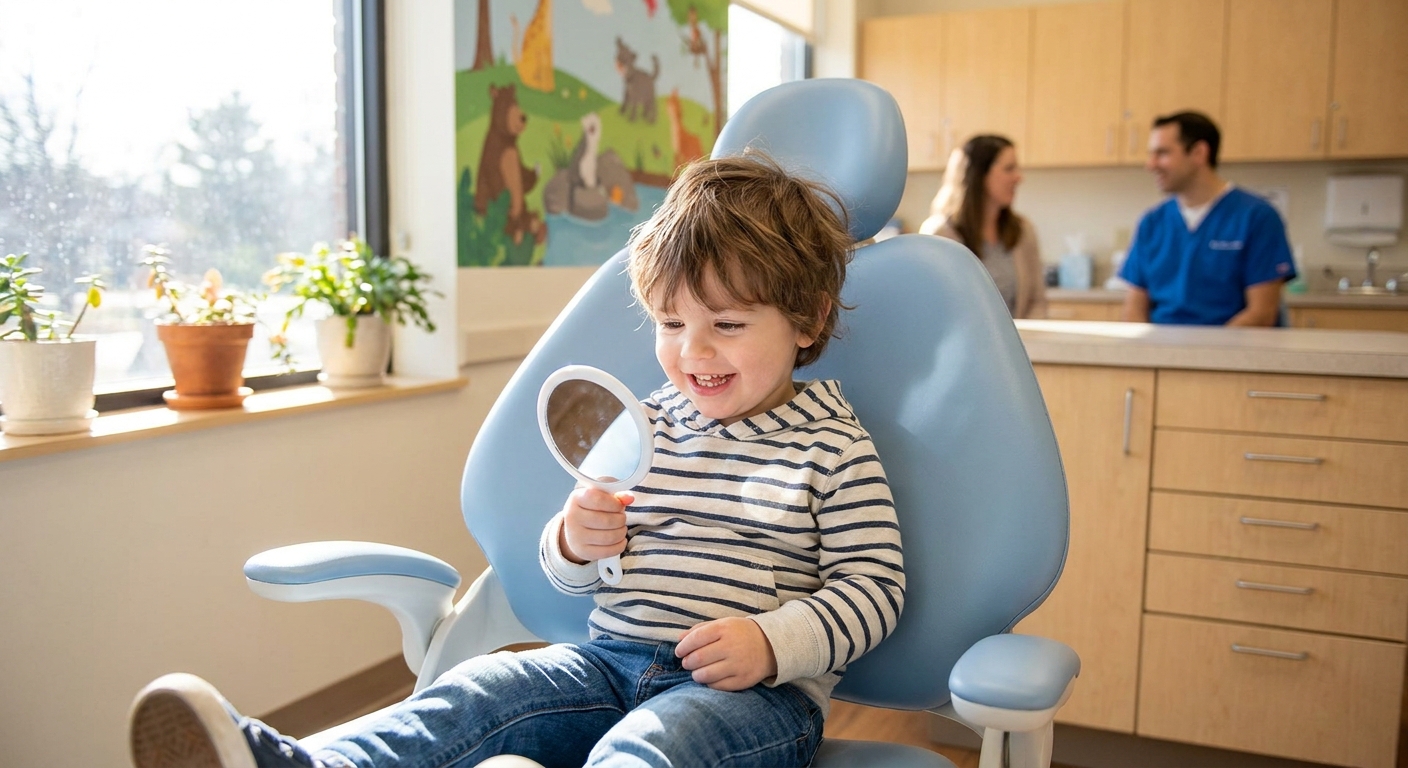
The visit starts at the front door. In a low-pressure setting, the team greets your child by name, speaks to them directly, and does not hurry anyone toward the chair. For toddlers, many dentists do the exam with the child sitting on a parent’s lap, or with parent and dentist sitting knee to knee while the child leans back between them, so your child can see your face the whole time. For an older child, the chair itself can be part of the welcome. Letting a child press the button that moves the chair up and down gives them a small sense of control, and control is the opposite of fear.
Next comes tell-show-do in action. Before anything goes in your child’s mouth, they can see it and often touch it: the small mirror gets a tap on the thumb, and the air sprayer tickles the back of a hand. The dentist then counts teeth out loud, checks the gums, and looks at how the bite is coming together. If your child is comfortable, a quick polish and fluoride may follow. Children should also have a clear way to say “I need a break,” such as raising a hand, and the adults in the room need to honor that signal every time. A practice built on comfort and respect does not force cooperation. A first visit that ends after only a tooth count still counts as a success, because your child leaves trusting the people who will care for them next time.
Your part matters too, and here is something many parents are never told: children read your tone more than your words. Phrases meant to comfort, like “it won’t hurt” or “don’t be scared,” actually put the words hurt and scared in a child’s head. Try neutral, upbeat language instead, such as “The dentist is going to count your teeth and make them shiny.” Because every child is different, it is fair to ask Gaston Dental Associates how they would pace a first visit for your child. A practice that promises special comfort and respect for anxious patients should welcome that question.
How Preventive Care Now May Help Save Your Family Money and Stress Later
After that first visit, regular checkups keep the momentum going. Preventive care may cost less than repair because it can catch problems while they are small or help stop them from starting, though outcomes depend on many factors including home care and individual health. A checkup and cleaning is a short, comfortable visit, while a cavity left alone can grow into a larger filling, an infection, or an emergency visit.
Think of it the way you think about oil changes. A quick, routine service every few months costs little and keeps the engine running, but skip enough of them and you may face a repair bill that dwarfs every oil change you avoided. Children’s teeth follow a similar pattern. Regular checkups may find a small soft spot in the enamel before it turns into a cavity big enough to cause pain. Professional cleanings remove buildup that brushing misses, especially on the back teeth that small hands struggle to reach.
Two preventive tools do much of the work in childhood. The first is fluoride, which strengthens developing enamel. Federal prevention guidance summarized by Healthy People 2030 supports applying fluoride varnish to children’s primary teeth starting when the first teeth appear. The second is sealants, a thin protective coating painted into the deep grooves of the back teeth, where food and bacteria tend to collect. The CDC encourages parents to talk with their child’s dentist about sealants because they may help prevent cavities. Sealants matter most when the permanent molars arrive, with the first set coming in around age 6 and the second around age 12. That makes roughly ages 6 to 14 a higher-risk window for cavities in those teeth.
The savings also may show up as less hassle. When one practice handles routine checkups and cleanings, preventive care, restorative dentistry, cosmetic dentistry, and emergency dental care, you do not have to juggle referrals, fill out new paperwork, or explain your child’s history again to someone new. Picture a chipped front tooth at soccer practice. Instead of scrambling to find someone who takes your insurance, you already know who to call. Gaston Dental Associates offers that full range in one Gastonia location, and it covers you as well. If you have been putting off a crown or living with a nagging toothache, the same team that sees your kids can see you.
Searching for a Kids Dentist Near Me in Gastonia? How to Choose One Your Child Will Want to See
Knowing what good care looks like may make the choice easier. Look for a practice that is close enough to make visits easy, accepts the insurance you already have, explains its approach to nervous kids in plain words, and can keep seeing your whole family as your needs change. That combination is what may turn dental visits into a routine instead of a battle.
You might be worried about something you have not said out loud. Maybe it has been a while since your child’s last visit, or there has never been one. Maybe you expect a lecture about juice cups or bedtime bottles. That worry is common, and it keeps many parents from picking up the phone. A practice that offers gentle, personalized care treats what you share as useful information, not as a reason to scold you. Your observations about your child, such as “she gags easily” or “he hates loud noises,” help the team adjust the visit for that day.
Location and continuity matter more than most parents expect. A short drive means less time for nerves to build in the back seat, and seeing the same faces at every visit means your child is not starting over with strangers each time. Gaston Dental Associates serves families across Gastonia, Dallas, Lowell, Belmont, and Cramerton, and the practice accepts Humana, Cigna, Aetna, United Healthcare, and Delta Dental. Benefits vary from plan to plan, so knowing your plan is accepted does not tell you what any single visit will cost. The simplest way to avoid surprises is to call with your insurance card in hand and ask what to expect before the appointment.
When you call any office, these questions will tell you a lot:
- How do you introduce instruments to a nervous child?
- Can I stay in the room during my child’s visit?
- What happens if my child needs a break or does not want to continue?
- Can you see me and my other children at the same office?
- Before any treatment beyond the exam, will you explain the cost?
A team that answers these questions patiently, without rushing you off the phone, is showing you how they will treat your child in the chair.
Questions Gastonia Parents Ask Before Booking a Kids Dentist
Here are short, direct answers to the questions parents usually raise before booking a first visit.
At what age should my child first see a dentist?
The American Academy of Pediatric Dentistry recommends a first visit when the first tooth appears and no later than your child’s first birthday. This early visit sets up a dental home, lets the dentist spot early issues, and may give your child a calm first memory before any problem develops.
What if my child is terrified of the dentist?
Fear is common, and it can be managed. Practices that use tell-show-do, move at your child’s pace, offer a clear signal for breaks, and never force cooperation may help anxious children build trust through respect. Gaston Dental Associates names special comfort and respect for anxious patients as one of its core principles, so let the team know about your child’s fear when you book and the first visit can be planned around comfort.
How much does a kids dental visit cost in Gastonia?
Cost depends on your child’s needs and your plan’s benefits. Many dental plans place a strong emphasis on preventive care such as checkups and cleanings, but the details vary. Gaston Dental Associates accepts Humana, Cigna, Aetna, United Healthcare, and Delta Dental, so call with your card and ask for an estimate before treatment.
Do I need a pediatric specialist, or can a family dentist treat my child?
Many children receive excellent care from a family dentist, especially at a practice focused on gentle care and anxious patients. Pediatric specialists complete extra training and may be the right fit for some complex needs. A good family dentist will tell you honestly if your child might benefit from a referral.
What happens if my child needs more than a cleaning?
A comprehensive dental home can handle fillings, other restorative work, and urgent problems in the same familiar office. Gaston Dental Associates offers preventive, restorative, cosmetic, and emergency dental care in one Gastonia location, so your family does not have to coordinate several offices as your child grows.
How do I know if a dentist is good with kids?
Listen to how they talk about their process. Whether you found them by searching for a kids dentist near me or through a friend’s recommendation, a dentist who is good with kids explains how they introduce new things, how they handle fear, and how they include you. They treat your concerns as part of the care plan, not an obstacle, and they never rush you or your child.
When you are ready, call Gaston Dental Associates in Gastonia to schedule your child’s first visit or to find a dental home that respects your family’s pace and concerns. Mention your child’s age, any worries they have, and your insurance plan so the team can prepare before you arrive.
One thing you can start tonight: play “dentist” at home for a week before the appointment. Have your child lie back on the couch, open wide, and let you count their teeth out loud while they watch in a hand mirror. When the dentist counts in the real chair, your child may already know the game, and that question from the back seat may be much easier to answer.
Help Your Child Build a Lifetime of Healthy Smiles
If you’ve been putting off your child’s dental visit because past experiences have been difficult, you’re not alone. At Gaston Dental Associates in Gastonia, our team understands that young patients need a different approach, one that builds confidence instead of anxiety. Let us show your family what truly gentle, patient-centered pediatric dental care looks like.
Individual responses to dental care vary based on many factors including age, oral health habits, anxiety level, and overall health; no approach works the same way for every child.